
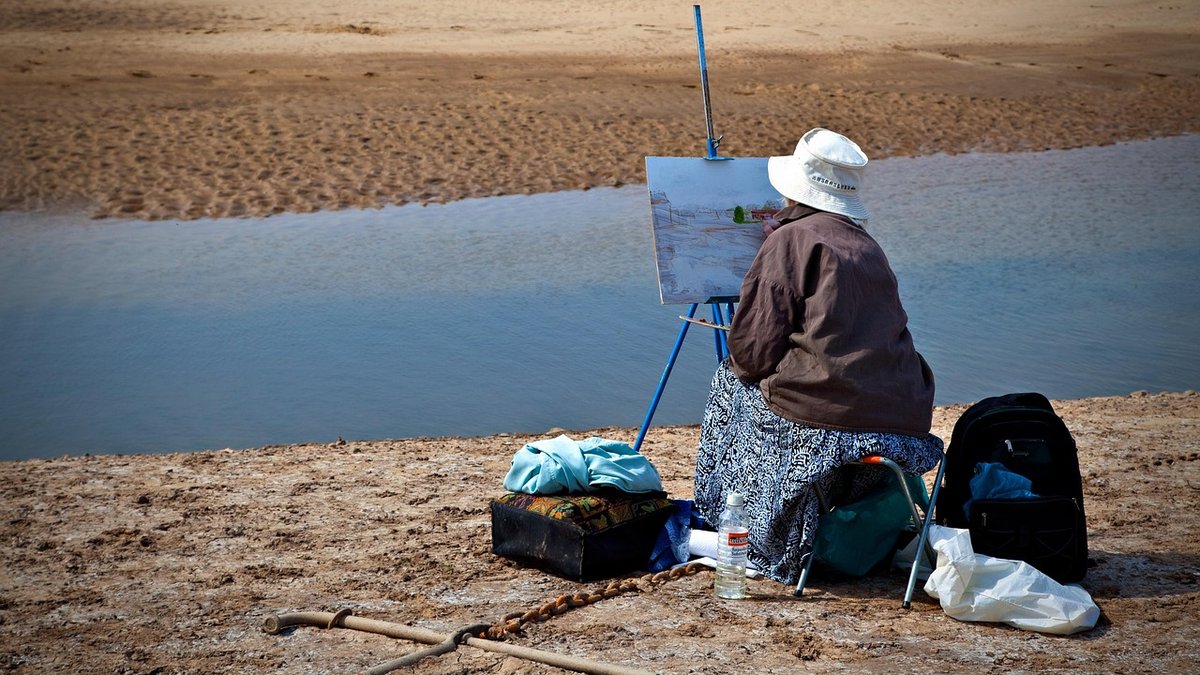
Most outdoor painting happens in a hurry. The light shifts, the wind gets up, the rain arrives, and you come home with a hurried sketch and only a vague memory of what made the view worth stopping for. An art journal solves that problem. It is not a finished painting and it is not meant to be. It is a record of what you noticed, written and drawn on the spot, and over a year it becomes the most useful reference you own.
Studio paintings go wrong when the colour gets invented. A journal stops you inventing. Six months later, when you want to paint that hawthorn hedge in late April, you will have the exact mix you used and the note that says the blossom read almost white against a cold grey sky, with the year's first green showing in the grass behind it. That is knowledge you cannot reconstruct from memory, and no photograph will give it to you.
Keep the kit small enough that you never leave it behind. A journal that lives in a drawer is no use at all, so the whole thing should fit in a coat pocket or the lid of a rucksack.
Leave the folding stool and the big palette at home. Ten minutes of standing sketching beats an hour of setting up equipment.
Paint your swatches directly into the book, never on a loose scrap you will lose by teatime. Squeeze the mix into a corner of the page, let it dry, then write beside it what you did. Three or four words is enough: ultramarine and a touch of burnt sienna, roughly three to one, for wet slate.
Greens cause more trouble than any other family of colours, so sample several from a single hedge. You will usually find a cold blue-green in the shadow, a warm yellow-green on the sunlit tips, and a dull olive where the leaves overlap. Note which one dominates. Note, too, the colour of the paper showing through, because the white of a sketchbook is far brighter than anything in the landscape, and it will lie to you about your values if you let it.
This is where most journals fall short. A page of drawings with no context is only half a record. Add a short block of writing at the bottom of every entry:
The single most valuable line you can write is about the sun. Something like: 4.15pm, early March, sun low behind my left shoulder, long blue shadows across the field, sky pale lemon at the horizon fading to cold grey overhead. A sentence like that will save you hours of guessing back in the studio.
Before a studio session, spread three or four journal entries on the table and choose a motif rather than a scene. Your notes will suggest the palette for you, because you already worked it out under the real light.
Trust the journal over the photograph for colour. The camera flattens warm and cool into the same dull middle, while your swatches remember the difference between a shadow that was violet and one that was simply dark. Use photographs for shapes and architecture, use the journal for everything else. And keep the writing brief and legible, because in a year's time a rushed scrawl will mean nothing at all.
Ten minutes on a walk you were taking anyway is enough to build the habit. Date every page, resist the urge to judge the drawings, and let the book get muddy. A journal that is too precious to take outdoors is already a failed one.

Hi, my name is Anthony kuber. I am artist and fashion designer.
I love to travel and writing blogging.
Your email address will not be published. Required fields are marked *
Software Developer & Writer
Hey, I'm Diva, a developer and writer blending code and creativity. I'm driven by a deep curiosity and a relentless pursuit of excellence. Join me as I craft digital solutions and captivating stories.


