
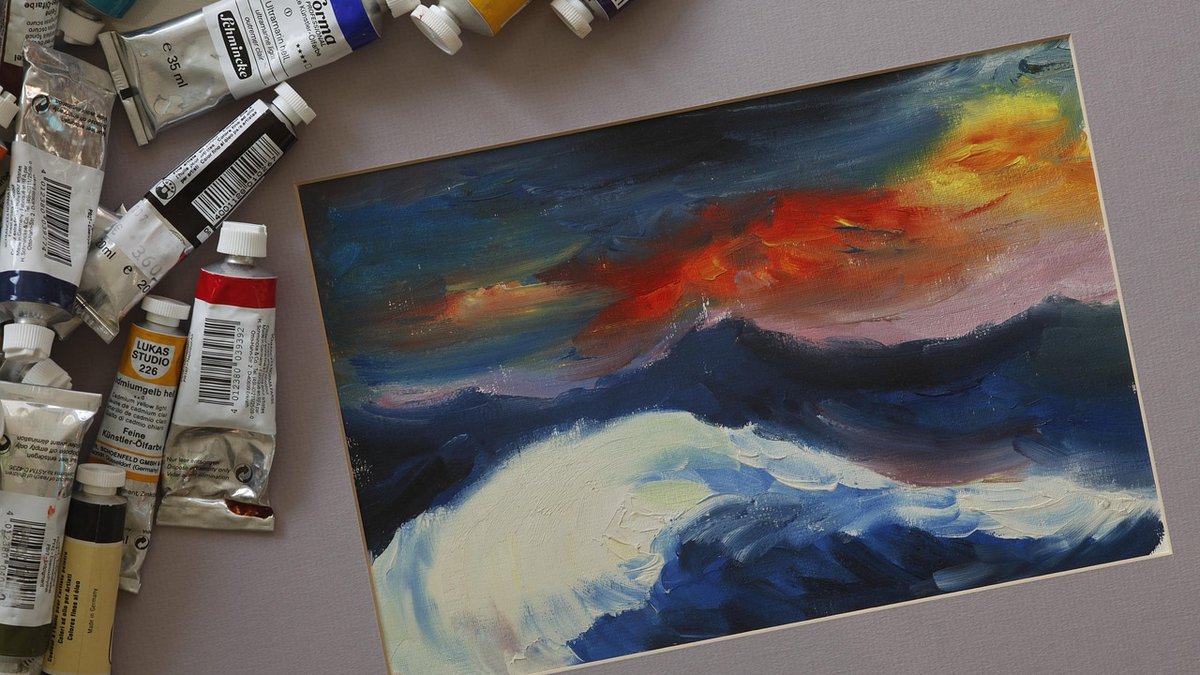
Gouache is the quiet hero of outdoor painting. It handles like watercolour when thin, but dries to a flat, opaque, matt finish that lets you paint light over dark. That matters in a hedgerow, where stems, thorns, leaves and flowers tangle into a dense mass. Watercolour asks you to preserve whites and work light to dark. Gouache lets you build the other way round: block in the dark structure of the hedge, then lay bright petals and sunlit leaves on top. It also dries quickly, so you can finish a study before the light shifts. On a breezy verge or a damp lane, that speed is a gift. You can carry a small palette, a water brush and a sketchbook, and work standing up if needed.
Keep the kit simple. A heavy sketchbook, a few brushes and a limited palette will get you further than a bulging bag. I take:
Work small. A 10 x 15 cm study is enough to capture a whole hedgerow. Small paintings force you to simplify, and they are easier to finish before the weather changes.
Begin with the skeleton of the hedge. Mix a dark green from ultramarine, burnt umber and a touch of alizarin crimson. Avoid black; it kills the life in foliage. With the rigger, paint the main stems, the thorny branches and the dark gaps between leaves. Think silhouette, not specimen. You are not drawing every twig. You are finding the shapes that hold the hedge together. Let this layer dry. Then mix mid greens: lemon yellow and ultramarine, with a little burnt sienna for an olive tone. Paint the leaf masses in broad, broken strokes with the flat brush. Leave gaps so the dark stems show through. For wildflowers, paint the stalks and calyxes now, before any petals. This dark-to-light order is the opposite of watercolour, and it is what gives gouache its punch. If you make a mistake, let it dry and paint over it. Opaque paint is forgiving.
Once the greens are dry, mix your flower colours. Keep them clean and slightly thicker than the underpainting. For cow parsley, use warm white with a touch of yellow ochre rather than straight titanium. For red campion, mix permanent rose with a little cadmium red. Poppies need cadmium red, a touch of orange and a deep crimson centre. Buttercups are cadmium yellow with a tiny white highlight. Foxgloves want a purple mixed from ultramarine and alizarin, lightened with white for the bells. Load the round brush and paint each petal with one stroke where you can. Touch, pull, lift. Do not overbrush. For clustered flowers, paint the general shape first, then add a few individual florets on top. Save pure white and pale yellow for the final highlights. A few small, bright touches will read as a whole drift of flowers. Stop before you add every petal.
Freshness comes from edges. A hedgerow is full of lost and found shapes: some leaves catch the light with a hard edge, others dissolve into shadow. Use the side of the flat brush for dry, scratchy marks on twigs. Scumble a little colour with hardly any water to suggest distant foliage. Soften an edge by dragging a clean, damp brush along it once. Do not outline every leaf or flower. Vary your pressure and turn the brush as you work. Let some marks stay accidental. If a passage becomes muddy, wait for it to dry, then lift with a clean damp brush and blot. Keep your palette limited and mix puddles rather than tiny dabs. Rinse your brush between tones, and change your water often. The aim is not botanical accuracy but the feeling of a hedge in light and air.
Cow parsley is an umbrella of tiny white heads: paint the green stem first, then dot warm white in a loose lace. Red campion has five notched petals; paint a deep pink star, then a lighter centre. Poppies are crumpled silk — four broad petals, a dark centre, and a thin, hairy stem. Buttercups are small and shiny; a cadmium yellow petal with a touch of white will suggest the gloss. Vetch climbs through grasses with small pea-like flowers; paint the curling stem, then two or three little wings. Foxgloves rise in a spire; block the dark throat of each bell, then lay purple over the top. Honeysuckle twists through the hedge with cream and yellow tubes. Dog roses are pale pink with yellow stamens. Paint the back of the hedgerow first, then the middle, then these front flowers. That order keeps depth and stops the painting looking flat.

Hi, my name is Anthony kuber. I am artist and fashion designer.
I love to travel and writing blogging.
Your email address will not be published. Required fields are marked *
Software Developer & Writer
Hey, I'm Diva, a developer and writer blending code and creativity. I'm driven by a deep curiosity and a relentless pursuit of excellence. Join me as I craft digital solutions and captivating stories.


